



The Swiss National Bank has pulled eight banks and market operators into a new study of whether Switzerland should run its money and securities on one shared ledger.
The project, announced on Tuesday, November 24, is called the Swiss Financial Ledger.
UBS, SIX, Zürcher Kantonalbank, PostFinance, Banque Cantonale Vaudoise, Basler Kantonalbank, Sygnum Bank and the settlement platform Seturion are all on board.
For anyone following tokenized assets, the important detail is the scope: central bank money, commercial bank money and securities on a single distributed ledger.
The bigger question is whether a famously cautious central bank is preparing for ledger-based finance, or only testing the idea.
What the Swiss National Bank Announced
According to the Swiss National Bank’s press release, the study sits inside Project Helvetia, the SNB’s long-running work on settling tokenized assets in central bank money.
It also builds on Project Agorá, a public-private initiative by the Bank for International Settlements and the Institute of International Finance.
Agorá looks at how tokenization can make wholesale cross-border payments faster, cheaper and safer.
The Swiss study asks a wider question. Could one Swiss Financial Ledger serve those cross-border flows and also act as a platform for domestic transactions?

ADVERTISEMENT
The participants will weigh technical design and architecture options, then define governance models and operating frameworks.
A new Helvetia Strategic Board, made up of the participating institutions, will steer the talks. The Swiss Bankers Association joins as an observer.
The SNB was careful with its wording. It said the project should not be read as a sign that such a ledger will launch, or that it will issue tokenized central bank money for financial institutions.
Who Is Missing, and Who Is New
Four of the eight participants already appear on the SNB’s list of banks eligible for wholesale central bank digital currency in the live Helvetia pilot: UBS, Zürcher Kantonalbank, Banque Cantonale Vaudoise and Basler Kantonalbank.
SIX runs the platform where that pilot happens, and its unit SIX SIS is on the list too.
PostFinance, Sygnum Bank and Seturion are not on the eligible list, which makes them the newcomers.
Five eligible names are absent from the new study: Aargauische Kantonalbank, Basellandschaftliche Kantonalbank, Commerzbank, Hypothekarbank Lenzburg and Raiffeisen Switzerland.
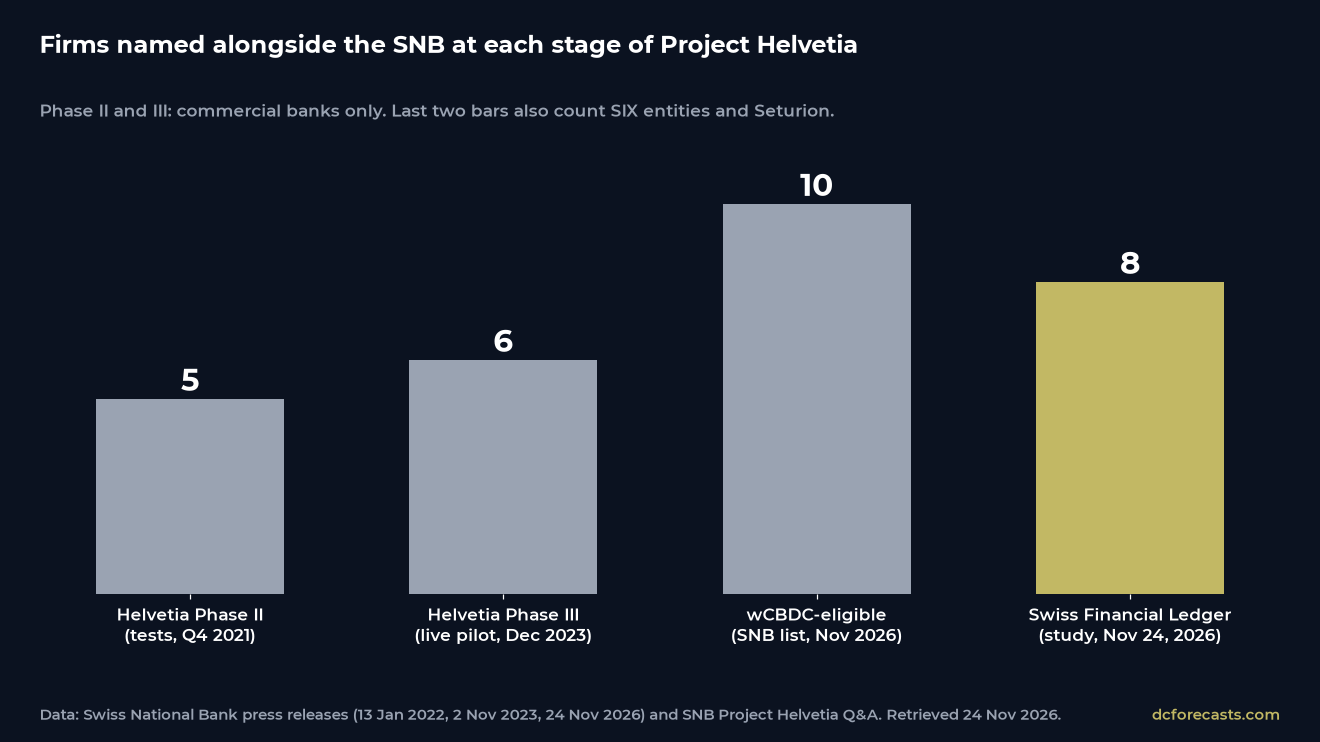
Sygnum is a regulated crypto bank, so its seat at the table brings direct digital-asset experience into the room.
Six Years of Project Helvetia in Numbers
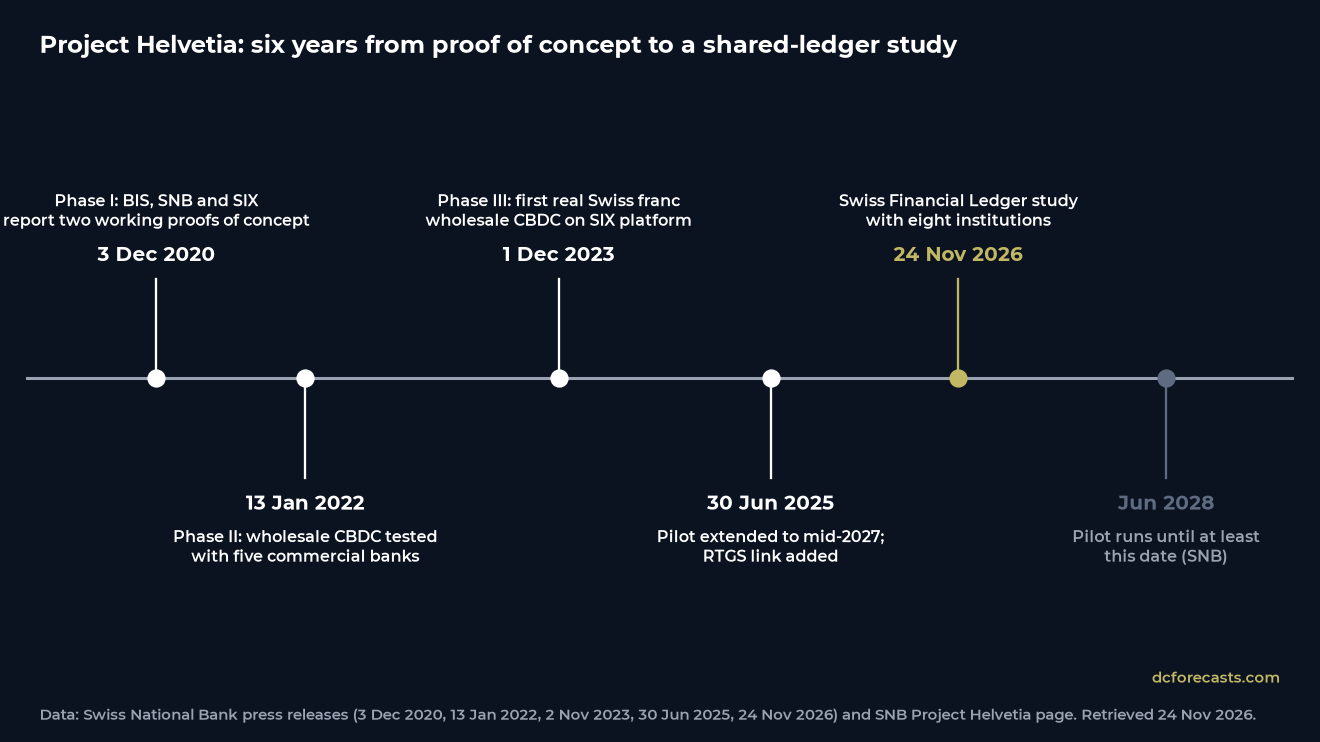
This is not a sudden move. The SNB, the BIS Innovation Hub Swiss Centre and SIX first reported two working proofs of concept on December 3, 2020.
Phase II followed on January 13, 2022. Five commercial banks, Citi, Credit Suisse, Goldman Sachs, Hypothekarbank Lenzburg and UBS, plugged wholesale CBDC into their own back-office systems during tests in the fourth quarter of 2021.
On December 1, 2023, the SNB moved from tests to production. Working with six commercial banks, it issued real Swiss franc wholesale CBDC for the first time on the SIX Digital Exchange.
That pilot was first scheduled to end in June 2024. On June 30, 2025, the SNB extended it to at least mid-2027 and added a link between tokenized-asset platforms and its Swiss Interbank Clearing system.
Its Helvetia page now says the project will run until at least June 2028.
The list of banks eligible to hold wholesale CBDC has also grown, from six at launch to ten institutions today, including SIX SIS. We believe that steady widening is the real signal.
Why Seturion Brings a Public Blockchain Into the Room
The SNB describes two routes to settling tokenized assets in central bank money.
One is integrated: tokenized francs and tokenized assets sit on the same ledger and change hands at the same moment.
The other is synchronized: assets move on a ledger while cash settles in the traditional Swiss Interbank Clearing system through a real-time gross settlement link.
SeturionX uses that link in a production environment, according to the SNB. It runs a small DLT trading system licensed by Swiss regulator FINMA.
Notably, the SNB says SeturionX settles its DLT assets on the public Ethereum blockchain, while the cash leg settles in central bank money.
A Swiss central bank project with a public-chain settlement firm on its strategic board is a meaningful shift from the closed test networks of 2020.
As we covered when the Bank of Israel shelved its retail digital shekel in favor of a wholesale pilot, central banks are steering their ledger work toward institutions, not households.
What the Swiss National Bank Study Means for Tokenized Assets and Bitcoin
For tokenized assets, a shared Swiss ledger could reduce the need to move money and securities across separate systems.
That fits a wider European pattern, including the plan for tokenized assets on EU pilot platforms to back ECB loans in 2027.
Bitcoin is not part of this project, and nothing in the SNB release touches it.
Still, we believe the direction is constructive for Bitcoin holders. Central banks are spending years studying how to settle value on shared ledgers, the core idea Bitcoin has run in production since January 2009.
The difference is control. The SNB’s ledger would be permissioned and governed by a board of institutions, while Bitcoin settles on an open network with no central operator.
That contrast is why Bitcoin remains a distinct asset. A tokenized franc depends on the SNB, while Bitcoin’s fixed 21 million supply depends on no institution.
What should readers watch next? Look for the Helvetia Strategic Board’s first findings on design and governance, any new banks joining, and whether Agorá’s cross-border work feeds directly into a Swiss platform.
The coming months will show whether Switzerland treats the Swiss Financial Ledger as an upgrade to its financial plumbing or as one more carefully worded experiment.
DC Forecasts is a leader in many crypto news categories, striving for the highest journalistic standards and abiding by a strict set of editorial policies. If you are interested to offer your expertise or contribute to our news website, feel free to contact us at [email protected]


